
Monitor the Future of Tech: American University in Dubai Hosts UAE AI Hackathon on Self-Improving Systems
Understanding the Shift Toward Self-Improving Systems
Artificial intelligence development has traditionally relied on static models. Engineers train a system on a specific dataset, test its performance, and deploy it. When the model’s accuracy degrades over time due to changing data patterns—known as data drift—developers must manually step in to retrain or fine-tune the system. This cycle is resource-intensive and limits the scalability of AI solutions.
The next major evolution in machine learning focuses on self-improving systems. These are autonomous agents designed to continuously evaluate their own performance, identify operational weaknesses, and close capability gaps without requiring human intervention or manual retraining. By implementing internal feedback loops, these systems can adapt to new information in real-time. Industry professionals and students who monitor these advancements closely recognize that mastering this technology is becoming a critical differentiator in the global tech landscape.
Inside the Ruya AI Hackathon at American University in Dubai
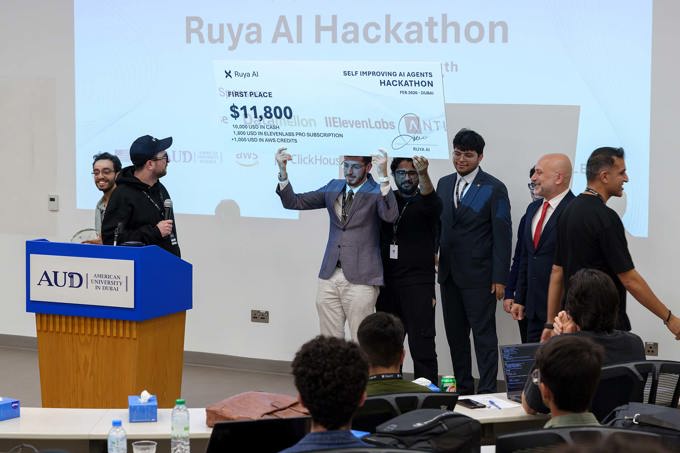
To address this complex technical frontier, the American University in Dubai (AUD) recently convened nearly 200 applicants from across the UAE for the Ruya AI Hackathon. Organized in partnership with Ruya AI and the U.S. Mission to the UAE, this intensive one-day competition brought together AUD students and regional engineering talent to build practical solutions centered around autonomous AI improvement.
Unlike traditional coding competitions that focus on building simple applications from templates, this UAE AI Hackathon required participants to architect complex systems capable of self-assessment. Participants had to design algorithms that could not only execute tasks but also critique their own outputs, adjust their internal parameters, and optimize their performance dynamically. This high standard of entry ensured that the event served as a rigorous testing ground for advanced engineering skills rather than a basic programming exercise.
Schedule a free consultation to learn more about AUD’s engineering programs.
Enterprise Tools and Industry Support
Building advanced self-improving systems requires significant computational power and access to cutting-edge foundation models. The Ruya AI Hackathon secured backing from leading technology sponsors, including AWS, ClickHouse, Datamellon, and ElevenLabs. This corporate support provided participants with enterprise-grade resources that are typically inaccessible to students and independent developers.
Throughout the competition, participants received access to Amazon Bedrock, a fully managed service that offers a choice of high-performing foundation models from leading AI companies. This allowed teams to experiment with complex model orchestration without worrying about underlying infrastructure management. Additionally, exclusive credits from ElevenLabs enabled participants to integrate sophisticated voice and audio generation capabilities into their autonomous agents. By working directly with these tools, hackathon attendees gained practical, hands-on experience that translates directly to modern workplace requirements.
The Role of Data Analytics in Autonomous Agents
Sponsorship from ClickHouse highlighted another critical component of self-improving systems: high-performance data analytics. For an AI agent to evaluate its own performance accurately, it must rapidly process large volumes of operational logs, user interactions, and error reports. ClickHouse’s column-oriented database management system is designed for exactly this type of real-time analytical processing. By integrating such databases, the teams participating in the AI Hackathon were able to build robust monitoring layers for their agents, proving that autonomous improvement relies just as heavily on fast data retrieval as it does on advanced machine learning algorithms.
High Stakes and Expert Evaluation
The competitive structure of the hackathon was underscored by a substantial $25,000 prize pool, reflecting the high value that the tech industry places on innovation in this specific niche. However, the financial incentive was matched by the opportunity for direct exposure to industry leaders. The judging panel featured distinguished experts from AWS, Palantir, ClickHouse, and Berkeley’s BASICS Startup Incubator.
Having evaluators from organizations like Palantir—known for building high-stakes data analytics platforms for government and enterprise clients—meant that participants had to defend their architectures against rigorous technical scrutiny. Teams were required to clearly articulate how their systems identified failure states, what mechanisms prevented infinite feedback loops, and how they ensured the self-improvement process remained stable. This level of evaluation bridges the gap between academic theory and enterprise-grade software development.
Submit your application today to join the next generation of AI innovators.
Why Engineering Professionals Should Monitor AI Competitions
For technology professionals, students, and academic institutions across the region, the Ruya AI Hackathon serves as a clear indicator of where the industry is heading. Traditional software engineering roles are rapidly evolving to require a deep understanding of machine learning operations (MLOps), agent orchestration, and dynamic parameter tuning.
Professionals who monitor hackathon trends can identify which frameworks and architectural patterns are gaining traction among top-tier engineers. For example, the shift from static API calls to agentic workflows—where AI models use tools, plan out multi-step processes, and correct their own mistakes—was highly visible at this event. Staying informed about these developments allows engineers to proactively update their skill sets, ensuring they remain competitive as enterprise demand for autonomous systems grows.
Building a Portfolio Through Competitive Development
Participating in a high-profile AI Hackathon provides tangible evidence of a developer’s capabilities. A resume listing experience with building self-improving agents using Amazon Bedrock and handling complex data flows through ClickHouse immediately stands out to recruiters. Furthermore, the collaborative nature of these events forces participants to practice version control, rapid prototyping, and technical communication under strict time constraints. These soft skills, combined with the hard technical deliverables, create a well-rounded professional profile.
Academic Pathways to Building Advanced AI Solutions
While hackathons provide an excellent environment for rapid innovation, a strong foundational education remains crucial for understanding the complex mathematics and theoretical computer science behind self-improving systems. The American University in Dubai directly supports this educational pipeline through its comprehensive academic offerings, most notably its Master of Science in Artificial Intelligence (M.S.).
Graduate programs like the M.S. in AI provide the structured environment necessary to understand the limitations and risks associated with autonomous systems. Students learn to formalize problems, design rigorous testing methodologies, and implement safety constraints—skills that are essential when building systems that modify their own behavior. The fact that the American University in Dubai hosts events like the Ruya AI Hackathon demonstrates its commitment to blending theoretical coursework with practical, industry-aligned experiences.
Undergraduate students in programs such as Computer Engineering and Electrical Engineering also benefit significantly from the university’s ecosystem. By exposing undergraduates to postgraduate-level competitions and enterprise tools, AUD prepares its student body to transition smoothly into advanced research roles or immediate employment in the UAE’s booming technology sector.
Explore our related articles for further reading on graduate admissions.
Preparing for the Next Generation of AI Development
The transition from static, trained models to autonomous, self-improving agents represents one of the most significant technical challenges in modern computer science. As demonstrated at the American University in Dubai, tackling these challenges requires more than just theoretical knowledge; it demands access to enterprise infrastructure, collaboration with industry experts, and a willingness to solve highly complex, open-ended problems.
For aspiring engineers and tech professionals in the UAE, the message is clear. Building basic chatbots or simple predictive models is no longer sufficient to stand out in a competitive job market. The focus must shift toward building resilient, self-correcting architectures that can operate with minimal human oversight. Engaging with university-led initiatives, leveraging cloud platforms like AWS, and continuously testing new methodologies are practical steps toward mastering this domain.
The Ruya AI Hackathon highlighted the immense talent present within the region and the robust support system provided by both academic institutions and global tech companies. As the boundaries of artificial intelligence continue to expand, the individuals and organizations that choose to monitor, adapt to, and invest in self-improving technologies will be the ones shaping the future of the digital economy.
Have questions? Write to us to learn how you can get involved in AUD’s tech initiatives.
Share your experiences in the comments below regarding AI competitions in the UAE.