Examine How American University in Dubai Students Drive Humanitarian Campaign Innovation in the UAE
Bridging Academic Theory and Real-World Social Impact
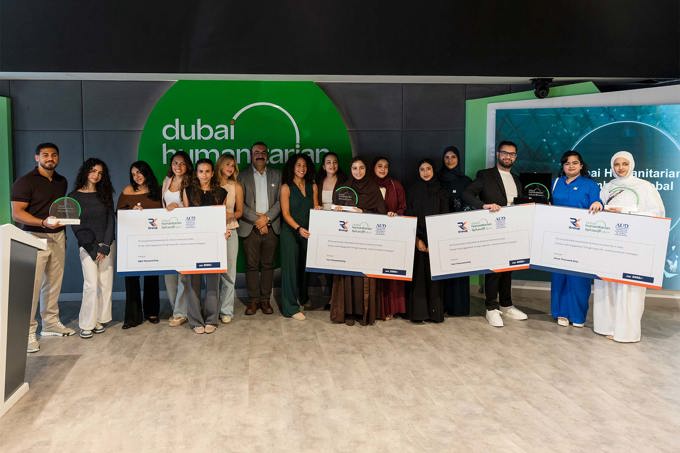
Higher education institutions are increasingly evaluated on their ability to connect classroom learning with tangible societal outcomes. To properly monitor the effectiveness of modern pedagogical strategies, one need only look at recent initiatives emerging from the American University in Dubai (AUD). Recently, AUD students were awarded for their exceptional work in designing a humanitarian campaign aimed at supporting global crisis response efforts. This recognition, which included substantial cash prizes, was earned during the AUD x Dubai Humanitarian Showcase 2026.
This event was not a standard academic exercise. It functioned as an interdisciplinary capstone project requiring students to address a live brief from Dubai Humanitarian. The objective was to raise awareness and drive engagement for the organization’s Global Humanitarian Impact Fund (GHIF). By shifting the focus from purely commercial marketing to social impact, AUD provided a framework for students to apply strategic communication tools to urgent global challenges. Schedule a free consultation to learn more about AUD’s interdisciplinary programs.
The Mechanics of Interdisciplinary Collaboration at AUD
The success of this initiative relied heavily on breaking down academic silos. The project brought together students from two distinct AUD faculties: the School of Business and the Mohammed Bin Rashid School for Communication. This intersection is where true student innovation flourishes. When future marketers collaborate with digital storytellers, the resulting campaigns benefit from both rigorous strategic alignment and compelling narrative structures.
Faculty leadership played a critical role in guiding this process. Dr. Farah Arkadan, Chair of the Department of Management and Marketing, and Prof. Roozbeh Kafi, Assistant Professor of Digital Production and Storytelling, co-led the initiative. Their guidance ensured that students did not merely create visually appealing content, but rather developed insight-driven strategies rooted in behavioral research. This approach mirrors the professional dynamics of top-tier agencies in the UAE, where cross-functional teams are standard. Submit your application today to join AUD’s School of Business or Mohammed Bin Rashid School for Communication.
Breakdown of the Winning Humanitarian Campaigns
A total of 45 students organized into nine interdisciplinary teams presented their concepts to a high-profile jury. The jury comprised senior leaders from major regional and international entities, including Emirates, Under Armour MENA, Home Bakery, Cinema Akil, RK Group, and Dubai Humanitarian. The presence of these industry professionals ensured that the campaigns were evaluated on real-world viability, creative execution, and potential for actual community engagement.
First Place: Run for More
Securing the top spot and an AED 8,000 cash prize, the “Run for More” campaign demonstrated how to effectively gamify charitable giving. Created by a six-student team, this concept likely leveraged community-based physical activity to drive donations. Campaigns that tie personal physical achievement to philanthropic goals often see higher engagement rates because they offer participants a dual benefit: physical wellness and social contribution. The strategy succeeded by creating a clear, actionable path for the public to support the GHIF.
Second Place: Something Big for Someone Else
Earning second place and AED 5,000, this campaign utilized a powerful psychological contrast. By framing the narrative around sacrificing a personal luxury—”something big”—to provide essential relief for another person, the students tapped into effective behavioral economics principles. This type of messaging forces the audience to reflect on their own consumption habits and reframe discretionary spending as a potential lifeline for those in crisis. It is a highly effective strategy for a humanitarian campaign operating in a commercially vibrant environment like the UAE.
Third and Fourth Place Strategies
The third-place campaign, “Your Delight, Their Relief,” which earned AED 4,000, operated on a similar principle of direct cause-and-effect messaging. It explicitly linked the donor’s positive experience with the recipient’s alleviation of suffering. Rounding out the top four, “Fly with Purpose” took home AED 3,000. Given the presence of Emirates on the judging panel, a travel or logistics-themed campaign showed astute audience awareness, cleverly aligning the act of travel or movement with purposeful humanitarian support.
Why Industry Partnerships Matter for Higher Education in the UAE
The structure of the AUD x Dubai Humanitarian Showcase 2026 highlights a crucial shift in higher education. Traditional learning often relies on hypothetical case studies. However, when students are required to pitch to the CEO of Dubai Humanitarian, Giuseppe Saba, and marketing leaders from multinational corporations, the stakes become real. Opening remarks at the jury day, delivered by AUD’s Provost Dr. Assaad Farah alongside Saba, reinforced the strategic necessity of these partnerships.
For the UAE’s evolving economy, which is actively diversifying and establishing itself as a global hub for humanitarian aid and logistics, this type of industry-connected learning is vital. Students graduate not just with theoretical knowledge, but with a portfolio of work that has been scrutinized by industry experts. They understand the pressure of deadlines, the nuances of client briefs, and the rigor required to defend a strategic concept under questioning. Explore our related articles for further reading on industry partnerships in UAE education.
Applying These Lessons to Your Own Academic or Professional Path
Whether you are a prospective student, a current undergraduate, or an early-career professional, the successes of these AUD students offer actionable insights into developing impactful social campaigns.
Focus on Behavioral Research
As Dr. Arkadan noted, the strongest ideas emerge when addressing real-life challenges through behavioral research. Before brainstorming creative concepts, invest time in understanding why people donate, what barriers prevent them from giving, and what triggers prompt immediate action. A humanitarian campaign must be rooted in human psychology, not just aesthetic design.
Prioritize Cross-Disciplinary Teamwork
If you are in a business program, seek out collaborators in communication, design, or engineering. The most robust solutions come from diverse perspectives. A data analyst might identify the optimal donation window, while a visual communicator crafts the exact message needed to convert that awareness into action. Student innovation is rarely a solitary endeavor.
Translate Urgency into Actionable Narratives
Prof. Kafi emphasized the need to translate humanitarian urgency into narratives that move people to care, engage, and act. Avoid relying solely on statistics or imagery of despair, which can lead to “compassion fatigue.” Instead, focus on empowerment, clear solutions, and the direct impact of the viewer’s contribution. Tell the audience exactly what their specific action will achieve.
Conclusion: The Future of Purpose-Driven Education
The recognition of AUD students in the Dubai Humanitarian collaboration serves as a clear indicator of where higher education must continue to move. By integrating experiential learning, fostering interdisciplinary teamwork, and partnering with prominent industry organizations, universities can produce graduates who are equipped to navigate complex societal challenges. The American University in Dubai has demonstrated that when students are given the resources, mentorship, and platform to address real-world issues, the resulting student innovation can rival professional industry standards. Have questions about studying in the UAE? Write to us!
As the landscape of global aid and corporate social responsibility continues to evolve, the demand for professionals who can seamlessly blend strategic marketing with compelling, purpose-driven storytelling will only increase. Evaluating and supporting these academic initiatives provides a valuable blueprint for the future of both education and humanitarian advocacy. Share your experiences with interdisciplinary learning in the comments below.