Monitor the American University in Dubai Strategic Partnership Advancing Interior Design Education in the UAE

Why Strategic Partnerships Matter for Interior Design Education in the UAE
The United Arab Emirates has established itself as a global hub for architectural innovation and luxury interior environments. As the region continues to develop complex commercial spaces, hospitality venues, and residential compounds, the demand for highly skilled interior designers has surged. For academic institutions, keeping pace with this rapid industry evolution requires more than just updating textbooks; it demands active collaboration with the professionals shaping the market. This necessity makes a strategic partnership an essential component of a reputable degree program.
When universities align with industry leaders, students gain direct access to the realities of the profession. They learn to navigate client expectations, understand material sourcing, and apply ergonomic standards that define modern spaces. Furthermore, faculty members are able to monitor emerging industry trends and integrate them into the curriculum before they become widespread. This proactive approach ensures that graduates are not just prepared for the industry as it stands today, but are equipped to adapt to the industry of tomorrow.
Schedule a free consultation to learn more about how industry-aligned education can shape your career path.
Inside the American University in Dubai and MillerKnoll Collaboration
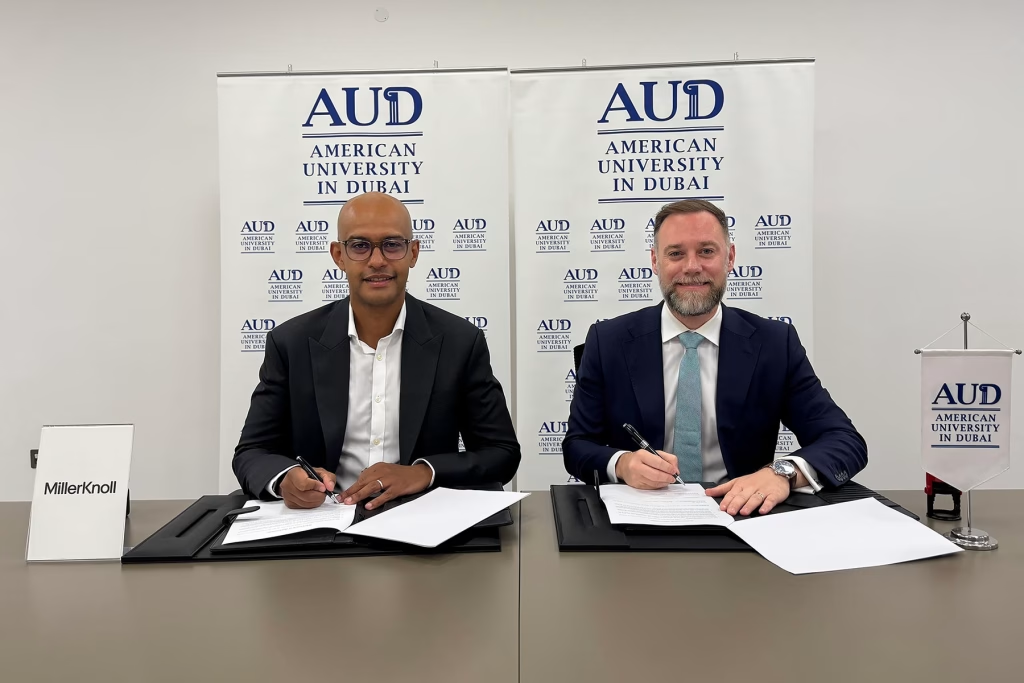
The American University in Dubai (AUD) recently reinforced its commitment to professional alignment by renewing its Memorandum of Understanding (MOU) with MillerKnoll. This strategic partnership focuses specifically on enhancing the Interior Design program within the School of Architecture, Arts & Design (SAAD). The signing ceremony, held on campus, was attended by key university figures, including President Dr. Kyle Long, Dr. Nabyl Chenaf (Dean of SAAD), and Professor Annamaria Lambri (Chair of the Interior Design Department). Representing MillerKnoll were Stacy Stewart, Senior Regional Director for the Middle East and Africa (MEA), and Nichola Harrison, A & D Manager MEA.
MillerKnoll is a collective of iconic design brands renowned for their research-driven approach to furniture and spatial solutions. By maintaining this formalized relationship, AUD ensures its Interior Design education remains deeply connected to a company that sets global standards for workplace and hospitality environments. The agreement serves as a structured framework for ongoing dialogue, resource sharing, and collaborative projects between the university and the corporate sector.
Bridging Academia and Professional Practice
A persistent challenge in higher education is the gap between theoretical knowledge and practical application. The AUD and MillerKnoll collaboration addresses this by creating structured touchpoints between students and active industry practitioners. Through this strategic partnership, students have the opportunity to engage with leading professionals who understand the constraints and possibilities of real-world design. This exposure helps students transition from an academic mindset to a professional one, learning how to balance aesthetic aspirations with functional requirements, building codes, and budget limitations.
Enhancing Faculty Engagement and Resources
The benefits of this collaboration extend beyond the student body. Faculty members at the American University in Dubai are able to leverage the partnership to stay abreast of the latest advancements in spatial design, sustainable materials, and ergonomic research. By interacting with MillerKnoll specialists, educators can refine their teaching methodologies and introduce case studies based on actual, large-scale projects executed in the UAE and globally. This continuous feedback loop allows the university to monitor the effectiveness of its academic offerings and adjust them to meet the exacting standards of the modern design industry.
How Students Benefit from Industry-Aligned Programs
Enrolling in an Interior Design program that features robust industry partnerships provides distinct advantages. For students at the American University in Dubai, the renewed MOU with MillerKnoll translates into several concrete educational benefits:
- Exposure to Contemporary Design Practices: Students gain firsthand insight into how leading brands conceptualize, test, and manufacture interior solutions. This includes understanding the lifecycle of design products from initial sketch to final installation.
- Understanding of Evolving Workspaces: The modern workplace is shifting rapidly toward flexible, hybrid environments. MillerKnoll is at the forefront of researching how these spaces function. Students learn to design offices that promote well-being, collaboration, and productivity.
- Hospitality Environment Focus: Given the UAE’s robust tourism sector, designing for hospitality is a critical skill. The partnership provides context on how premium furniture and spatial planning contribute to the guest experience in hotels and resorts.
- Professional Networking: Interactions with regional directors and design managers give students the chance to build professional relationships early in their academic careers, providing a significant advantage when entering the job market.
The Role of Real-World Exposure in Modern Design Curricula
Interior design is an inherently applied discipline. While studying color theory, spatial geometry, and design history is foundational, these concepts must ultimately be tested against physical spaces and human behavior. A curriculum that incorporates real-world exposure requires students to solve complex problems, much like they will in their future careers.
When students are tasked with projects tied to industry partners, they must learn to monitor project parameters closely. They must account for acoustics, lighting, material durability, and user ergonomics. The integration of a partner like MillerKnoll into the academic framework ensures that students are not designing in a vacuum. Instead, they are designing with an awareness of commercial product specifications, sustainability initiatives, and the practical maintenance requirements that facility managers demand. This level of rigor elevates the quality of student portfolios, making them highly competitive for internships and entry-level positions.
Choosing the Right Interior Design Program in the UAE
For prospective students evaluating their options for Interior Design education in the UAE, the presence of active, high-level industry partnerships should be a primary deciding factor. A degree is a significant investment, and its value is largely determined by the doors it opens upon graduation. When researching institutions, consider the following criteria:
- Accreditation: Ensure the program holds recognized regional and international accreditations, which validate the quality of the education provided.
- Industry Ties: Look for evidence of strategic partnerships, like the one between the American University in Dubai and MillerKnoll. These relationships indicate that the institution is respected by the professional community.
- Facilities: Evaluate the campus studios, fabrication labs, and library resources. Access to high-quality physical spaces is essential for developing tangible design skills.
- Faculty Background: Investigate whether the faculty members possess active industry experience alongside their academic credentials.
- Alumni Success: Research where graduates are currently employed. A strong alumni network in top regional design firms is a strong indicator of program quality.
The American University in Dubai continues to demonstrate its dedication to these standards. By renewing its strategic partnership with MillerKnoll, AUD provides a clear signal to prospective students that its Interior Design education is serious, forward-thinking, and deeply embedded in the professional world.
Have questions? Fill out the form! We are ready to help you navigate your academic options in design.
Preparing for a Career in a Competitive Market
The field of interior design in the UAE is highly competitive, attracting talent from around the globe. To succeed, graduates must possess more than just technical drawing skills; they must be strategic thinkers, effective communicators, and collaborative team members. Programs that integrate corporate partnerships inherently teach these soft skills by requiring students to present their ideas to industry critics, defend their design choices, and iterate based on professional feedback.
As the boundaries between architecture, interior design, and technology continue to blur, the ability to monitor technological advancements—such as Building Information Modeling (BIM), virtual reality walkthroughs, and sustainable material engineering—becomes increasingly important. The collaboration between AUD and MillerKnoll ensures that students are exposed to these intersections, preparing them to contribute meaningfully to multi-disciplinary design firms from their very first day on the job.
Explore Your Future in Design
Inspired by the opportunities emerging in interior design education at the American University in Dubai? Fill out the form to schedule a free consultation with an expert advisor who can guide you through studying in the UAE, explain program options at AUD, and help you take the next steps toward building a successful career in design and the creative industries.