Monitor Student Innovation Success at the American University in Dubai in the UAE L’Oréal Brandstorm Competition
Assess the Impact of Cross-Disciplinary Collaboration in University Competitions
Industry professionals and academic institutions should monitor how cross-disciplinary collaboration drives student innovation in higher education. The recent performance of American University in Dubai (AUD) students in the 2026 L’Oréal Brandstorm Competition provides a clear case study. AUD achieved a distinctive milestone by becoming the only university in the region to place three separate teams in the Top 10 of this international innovation challenge. This success was not confined to a single academic department; rather, it relied heavily on merging the strategic insights of marketing students with the technical capabilities of engineering students.
In the modern business landscape, particularly within the UAE’s rapidly diversifying economy, complex problems rarely exist in silos. Developing a technologically advanced consumer product requires an understanding of both the underlying hardware or software and the go-to-market strategy. By breaking down traditional academic barriers, universities can equip students with a more holistic skill set. When engineering students collaborate with advertising and integrated marketing communications students, the resulting projects feature viable technical frameworks supported by compelling, consumer-centric narratives. This approach mirrors the cross-functional teams found in leading global corporations, giving participating students a significant advantage before they even enter the workforce.
Schedule a free consultation to learn more about cross-disciplinary academic programs.
Review the 2026 L’Oréal Brandstorm Competition Challenge Parameters
To understand the magnitude of the American University in Dubai achievement, it is necessary to examine the specific parameters of the 2026 L’Oréal Brandstorm Competition. L’Oréal structures this annual event to identify and cultivate emerging talent by presenting them with real-world, high-stakes industry challenges. For the 2026 iteration, the brief tasked participants with reimagining the future of luxury fragrances.
Students were instructed to develop concepts that were distinctly technology-driven and highly consumer-centric. The brief explicitly required participants to address and integrate several critical industry themes:
- Personalization: Moving beyond standard fragrance profiles to offer individualized scent experiences.
- Inclusivity: Ensuring luxury products are accessible and appealing to a broader demographic, including individuals with physical limitations.
- Sustainability: Addressing the environmental impact of packaging, ingredient sourcing, and product lifecycles.
- Emotional Connection: Finding new ways to tie a physical product to the psychological and emotional state of the consumer.
Navigating these overlapping requirements demanded a high level of strategic thinking and creative problem-solving. The teams from the American University in Dubai had to ensure their concepts were not only imaginative but also feasible, scalable, and aligned with the luxury positioning of L’Oréal’s global brands.
Explore YSL Access: Redefining Inclusive Fragrance Packaging
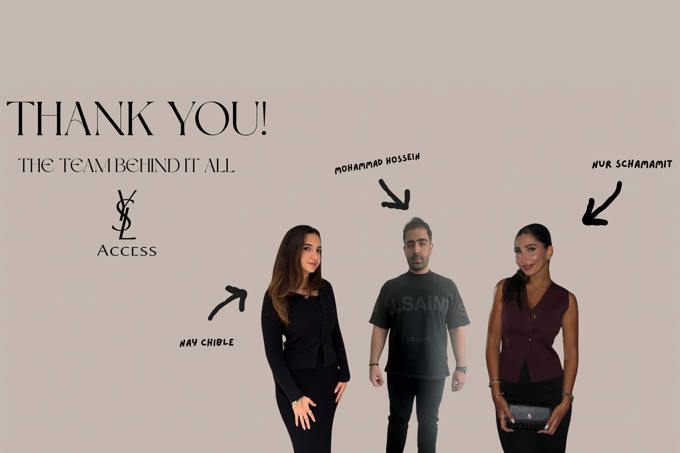
One of the qualifying teams from AUD, operating under the name “YSL Access,” tackled the theme of inclusivity head-on. Team members Nur Schamamit, Mohammad Hossein, and Nay Chible recognized a significant gap in the luxury fragrance market: packaging design often excludes individuals with limited hand dexterity or other physical disabilities. Traditional perfume bottles frequently feature complex caps, heavy glass, and intricate spray mechanisms that can be difficult or impossible for some consumers to operate independently.
YSL Access proposed a specialized, accessible iteration of YSL fragrances. Their concept reimagined the physical packaging and dispensing mechanism to create a user-friendly experience without compromising the premium aesthetic associated with the YSL brand. By prioritizing ease of use and independence, the concept reinforced YSL’s core brand values of freedom and self-expression. This type of student innovation demonstrates a mature understanding of universal design principles. It highlights an important shift in the luxury sector, where exclusivity in terms of price point does not have to mean exclusivity in terms of physical accessibility. For businesses operating in the UAE and globally, this concept serves as a reminder to continuously audit product lines for overlooked consumer segments.
Investigate Scentrix: Using AI to Convert Emotions into Scent Profiles
Another Top 10 finalist, “Scentrix,” utilized artificial intelligence to address the competition’s mandate for personalization and emotional connection. Comprised of Chantal Bachour, Noor Albastaki, and Majid Taha, the team developed a concept called “Scentrix YSL Mémoire.” This idea leveraged AI technology to translate human emotions into highly personalized fragrance profiles.
The underlying science of the Scentrix concept is grounded in the biological reality that human emotions trigger specific chemical reactions within the body, which in turn alter a person’s natural scent. The team proposed an AI-driven system capable of analyzing a user’s current emotional state—such as happiness, stress, or excitement—and using that data to generate or recommend a unique scent profile. Rather than selecting a perfume off a shelf based solely on preferred fragrance families (e.g., woody, floral, citrus), the consumer would receive a dynamic product tailored to their real-time physiological and emotional state.
This application of AI moves beyond basic data analytics into the realm of biometric customization. It represents a significant leap in how consumer goods can interact with the human body. For marketers and product developers, Scentrix illustrates how integrating advanced technology can shift a product from being a static, standardized item into an active, identity-driven experience.
Explore our related articles for further reading on AI applications in marketing.
Understand ABA Studio: Customizing Fragrance Memories
The third American University in Dubai team to reach the Top 10 was “ABA Studio,” consisting of Abdulmajeed AlSohaibi, Bachar Sitory, and Abdulla Kazim. Their concept, titled “Your Scent. Your Memory,” focused on the psychological link between olfaction (the sense of smell) and memory retention. Scent is widely recognized as one of the most powerful triggers for autobiographical memories.
ABA Studio proposed an AI-guided retail experience allowing consumers to craft bespoke fragrances that served as tangible representations of specific memories or identities. The process involved users selecting custom fragrance notes, testing their blends in real-time, and personalizing their physical bottle with meaningful labels. Once perfected, the unique scent profile would be saved digitally, allowing the consumer to order exact refills in the future. This concept successfully bridged the digital and physical retail environments. It provided a scalable solution for mass personalization—a major hurdle in the luxury perfume industry—by using AI to guide the consumer through a complex formulation process, making bespoke fragrances accessible to a wider audience.
Identify the Role of Faculty Mentorship in Fostering Student Innovation
While the students executed the concepts, the structural support provided by the American University in Dubai faculty was a critical component of this success. Two of the qualifying teams were cross-disciplinary collaborations mentored by Dr. Pakinam Nazmy, Assistant Professor of Marketing, with technical support from Dr. Vinod Pangracious, Chair of the Department of Electrical and Computer Engineering. The third team, composed of senior marketing students, worked under the guidance of Dr. Farah Arkadan, Chair of the Department of Management and Marketing.
Faculty mentorship in these competitions extends beyond basic academic advising. As Dr. Nazmy noted, the Brandstorm challenge pushed students to think beyond traditional perfume experiences and explore creativity and innovation in entirely new dimensions. Mentors provide the necessary guardrails to ensure that highly creative ideas remain feasible and aligned with the judging criteria. Dr. Arkadan emphasized that the competition allows students to engage with a real industry brief and present to a panel of expert judges, forcing them to balance their creative impulses with strategic, scalable, and sustainable business practices. This hands-on guidance is essential for translating theoretical classroom knowledge into executable business strategies.
Have questions about the role of faculty mentorship? Write to us!
Apply Lessons from the American University in Dubai to Your Academic Career
The achievements of these three teams offer actionable insights for prospective and current university students in the UAE and beyond. To replicate this level of student innovation, students should actively seek out opportunities that bridge different academic disciplines. If you are a business student, find ways to collaborate with engineering or design students. If you are an engineering student, take the time to understand the market positioning and consumer psychology behind the products you are building.
Furthermore, students should actively participate in international competitions like the L’Oréal Brandstorm Competition. These platforms provide a unique testing ground for ideas that differs significantly from standard coursework. They require participants to adhere to strict deadlines, satisfy complex corporate briefs, and defend their ideas under pressure from industry professionals. Engaging in these extracurricular challenges builds a robust portfolio of demonstrable skills that appeal strongly to future employers in the UAE’s competitive job market.
Finally, utilize the resources available on your campus. Establish relationships with professors who have industry experience and who are willing to mentor ambitious projects. The success of the American University in Dubai teams proves that when institutional support, cross-disciplinary collaboration, and student drive align, the results can compete on a global scale.
Submit your application today to join a forward-thinking academic community in the UAE.