Assess the Impact of Humanities Research at the Middlesex University Dubai Undergraduate Competition
Fostering Interdisciplinary Student Engagement in the UAE
The higher education landscape in the UAE continues to evolve, placing a stronger emphasis on practical, research-based learning that extends beyond traditional classroom lectures. At the center of this academic shift is the focus on student engagement through hands-on, inquiry-based initiatives. Middlesex University Dubai recently demonstrated its commitment to this educational approach by hosting a major academic event that brought together bright minds from across the region. By providing a formal stage for scholarly dialogue, the university reinforces the idea that undergraduate studies should actively involve the production of new knowledge rather than just the consumption of existing literature.
This focus on active participation is particularly vital in the humanities and social sciences, where nuanced understanding and critical analysis are paramount. When students are given the opportunity to formulate research questions, gather data, and present their findings to a panel of experts, they transition from passive learners to active contributors in their respective fields. The recent event hosted by Middlesex University Dubai served as a prime example of how academic institutions can cultivate a vibrant research culture at the undergraduate level, specifically tailored to the unique demands of human-centred disciplines.
The Role of Human-Centred Inquiry in Modern Academia
In an era increasingly dominated by rapid technological advancement and automation, the value of human-centred inquiry remains absolute. While technical skills are highly sought after, the ability to understand human behavior, interpret complex social dynamics, and communicate effectively across cultures are competencies that cannot be easily replicated by machines. Humanities research provides the framework for developing these essential soft skills.
By prioritizing human emotion, interaction, and intelligence, academic programs in the humanities ensure that future professionals are equipped to navigate the ethical and societal implications of new technologies. The emphasis on human-centric values in academic research ensures that as industries innovate, they do so with a clear understanding of their impact on real people. This balanced approach to education is what makes interdisciplinary student engagement so critical for the modern workforce.
Structure and Scope of the HASS Undergraduate Competition
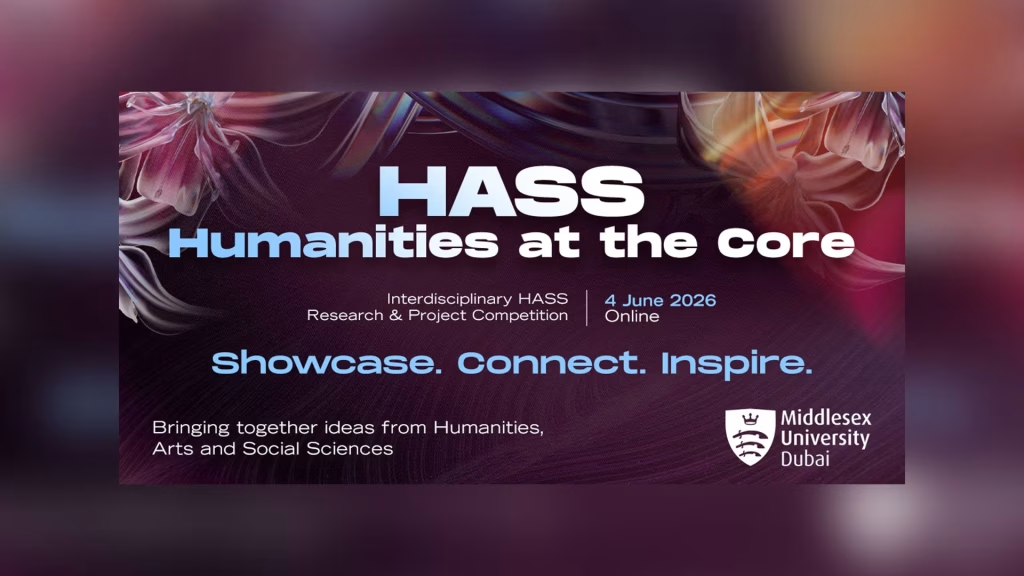
The Interdisciplinary HASS: Humanities at the Core Undergraduate Student Project and Research Competition was held on June 4, 2026. Conceived and organized by Dr. Ruta Vaidya, Senior Lecturer in Journalism and Digital Media, and Dr. Yousra Osman, Senior Lecturer in Education, the event was designed specifically to highlight project and research work rooted in the humanities. The structure of the competition required participants to not only submit written academic work but also present their findings verbally, defending their methodologies and conclusions in real-time.
This dual-format approach mirrors the standards of professional academic conferences, providing students with a realistic preview of what a career in research or higher education entails. The organizers successfully created an environment that was both academically rigorous and highly supportive, encouraging students to take intellectual risks in their presentations.
Diverse Academic Disciplines Represented
Approximately 40 students participated in the event, representing a wide array of institutions across the UAE, including the American University in Dubai, United Arab Emirates University, Murdoch University, Abu Dhabi University, the American University of Ras Al Khaimah, and Middlesex University Dubai. The submissions spanned multiple disciplines, prominently featuring Linguistics, Sociology, Media, Education, and Psychology.
This disciplinary diversity is a hallmark of effective humanities research. Unlike highly siloed technical fields, the humanities thrive on the intersection of ideas. A project in media studies, for example, inherently borrows from sociology and psychology to analyze audience reception and behavioral impact. By bringing these varied disciplines together under one roof, the competition highlighted the interconnected nature of human-centred inquiry and demonstrated how different academic lenses can be applied to understand complex societal issues.
Evaluation by Industry Experts
To ensure the academic integrity and professional relevance of the event, the projects were evaluated by approximately 15 judges and industry experts. These evaluators brought specialized knowledge from fields including Media, Education, Health, Psychology, and Sociology. The presence of industry professionals alongside academic faculty members provided students with a comprehensive feedback loop.
Students received critiques not only on their theoretical frameworks and academic rigor but also on the practical applicability of their research. This interaction bridges the gap between academic theory and industry practice, showing students exactly how their humanities research can be leveraged in real-world professional contexts.
Connecting Academic Theory with Professional Practice
A recurring theme throughout the event was the direct applicability of humanities research to the professional world. The inclusion of a keynote address by Hind Galadari, General Manager at Warner Bros., underscored this connection. Galadari spoke on the enduring importance of human-centric values in today’s corporate and media environments, a theme that aligned seamlessly with the core focus of the competition.
Keynote Insights on Human-Centric Values
When high-level executives from major global corporations advocate for human-centric values, it sends a clear message to undergraduates: the skills developed through humanities research are highly valued in the job market. Galadari’s insights provided students with a tangible example of how understanding human behavior, cultural nuances, and emotional intelligence are critical assets in leadership, media production, and corporate management.
For students attending the event, this keynote served as a practical validation of their academic pursuits. It demonstrated that the critical thinking and analytical skills honed through analyzing sociological trends or educational frameworks translate directly into competitive advantages in the corporate sector. The ability to communicate clearly, empathize with diverse audiences, and ethical decision-making are all rooted in humanistic study.
Why Undergraduate Research Matters for Career Readiness
Participating in an undergraduate competition of this caliber provides students with a distinct advantage in the competitive job market. While a degree demonstrates that a student has completed a course of study, presenting original research proves that they can apply that knowledge independently. Employers actively seek candidates who can identify problems, synthesize information from various sources, and propose evidence-based solutions.
Developing Critical Analysis and Communication Skills
The process of preparing for a research competition requires students to engage in deep critical analysis. They must review existing literature, identify gaps in current understanding, and design methodologies to address those gaps. Furthermore, the act of presenting their findings forces students to distill complex academic concepts into clear, accessible language. This ability to communicate specialized information to a non-specialist audience is one of the most valuable skills an undergraduate can develop.
Whether a student plans to pursue postgraduate studies, enter the corporate world, or transition into the non-profit sector, the ability to articulate ideas confidently and respond to unprompted questions from experts is an indispensable professional skill. The HASS competition provided a low-stakes, highly supportive environment for students to practice and refine these abilities before entering the workforce.
Networking and Cross-Institutional Collaboration
Beyond skill development, undergraduate research events serve as vital networking hubs. By bringing together students from six different universities in the UAE, the competition fostered a sense of regional academic community. Students had the opportunity to exchange ideas with peers from different institutional backgrounds, exposing them to new perspectives and methodological approaches.
Networking with the 15 judges and industry experts also opens doors for future internships, mentorships, and collaborative projects. Building these professional relationships early in an academic career can significantly alter a student’s trajectory, providing them with guidance and opportunities that are not available through standard coursework alone.
Building a Collaborative Academic Community
The success of the HASS competition was not solely dependent on the students; it relied heavily on the collaborative efforts of the faculty and staff at Middlesex University Dubai. Sessions were chaired and moderated by a dedicated group of academics, including Dr. Daphne Demetriou, Associate Professor of Law and Politics; Dr. Lynda Hyland, Associate Professor of Psychology; Dr. Ambreen Mohammad, Senior Lecturer in Education; Seada Kassie, Senior Lecturer in Psychology; and Navya Chanolien, Lecturer in Law.
This cross-departmental involvement reflects MDX Dubai’s broader institutional commitment to breaking down academic silos. When faculty members from Law, Psychology, and Education come together to facilitate a media and humanities-focused event, it models the exact interdisciplinary collaboration that students are encouraged to practice in their own work.
Reflecting on the success of the initiative, Dr. Yousra Osman noted that organizing the competition was a highly rewarding experience because it emphasized that true learning occurs when boundaries between disciplines and institutions are crossed. Seeing student creativity and critical thinking on display served as a powerful reminder of why human-centred inquiry is increasingly relevant in contemporary society. Similarly, Dr. Ruta Vaidya highlighted that the event successfully brought humanities disciplines to life, proving that despite massive advances in technology and innovation, human interaction, emotion, and intelligence remain essential components of a functioning society.
Preparing for Future Humanities Research Initiatives
For prospective and current students looking to participate in future undergraduate competitions, the key takeaway is to start viewing coursework as a foundation for independent inquiry. The best research projects often stem from a question raised during a standard lecture or a topic that a student found particularly challenging or intriguing. Students should actively seek out faculty mentors who share their academic interests and express their desire to engage in research early in their undergraduate careers.
Developing a strong research proposal requires time, patience, and a willingness to revise initial hypotheses based on preliminary findings. Students should take advantage of the resources offered by their university’s library, writing centers, and research offices. Engaging with peer-reviewed academic journals, even at the undergraduate level, helps familiarize students with the formal tone, structure, and rigorous standards expected in academic publishing and conference presentations.
The Interdisciplinary HASS competition has set a strong precedent for humanities research in the UAE. It proves that there is a robust appetite for platforms that validate and celebrate student-led inquiry in the social sciences. As universities continue to expand their research outputs, providing these foundational opportunities for undergraduates will be crucial in developing the next generation of scholars, thinkers, and industry leaders who understand the intrinsic value of the humanities.
Start Your Journey at Middlesex University Dubai
Interested in studying at Middlesex University Dubai? Fill out the form to get personalized guidance from Studygram’s expert team. You’ll receive support in choosing the right program, understanding admission requirements, and completing your application. Begin your educational journey with confidence and the guidance you need to succeed.