Monitor How the American University in Dubai UAE Engineering Competition Trains Future Innovators
How Practical STEM Events Build Future Innovators in the UAE
The transition from high school classrooms to university engineering labs requires more than just passing grades in mathematics and physics; it demands practical, hands-on problem-solving skills. In the UAE, the rapid pace of infrastructural and technological development has created a strong demand for highly skilled engineers. To meet this demand, educational institutions are stepping outside traditional pedagogical frameworks to offer interactive learning experiences. Recently, the American University in Dubai took a leading role in this effort by hosting a specialized engineering competition for high school students.
This event brought together 84 students from various schools across the UAE, providing them with a platform to apply theoretical concepts to tangible engineering problems. For educators and parents, it is highly recommended to monitor how students engage with these types of experiential learning opportunities, as they serve as strong indicators of a student’s readiness for a rigorous university engineering program. By participating in structured, competitive environments, students develop the resilience and analytical thinking required to succeed as future innovators.
Schedule a free consultation to learn more about university engineering readiness.
Breaking Down the American University in Dubai Engineering Competition Challenges
The success of any engineering competition lies in its ability to accurately reflect the multidisciplinary nature of the field. The American University in Dubai structured its event around three distinct challenges, each targeting a different facet of modern engineering. This approach allowed participants to explore various disciplines and identify where their specific interests and strengths lie.
The Game Design Challenge: Applying Logic and Coding
Software engineering and computer science are foundational pillars of the modern tech ecosystem. The Game Design Challenge required students to step into the role of software developers by creating simple interactive applications or games. This task went far beyond basic coding; it required students to employ computational thinking, logical sequencing, and creative design.
Participants had to conceptualize a user experience, write functional code, and debug their applications in real time. This challenge accurately reflects the daily realities of computer engineers and software developers. Ousama Alhenaawi and Anas Zidan from Al Maarifa International School secured first place in this category by demonstrating exceptional logic and creativity, followed by Jassim Ahmad Ahli and Zayed Marwan AlMaramah from Applied Technology Schools in second place, and Ahmad Rushed Al Meheri, also from Applied Technology Schools, in third.
The Tinkercad Challenge: Mastering Computer-Aided Design
Before any physical product or structure is built, it must be modeled digitally. The Tinkercad Challenge introduced students to the fundamentals of Computer-Aided Design (CAD). CAD software is an indispensable tool across multiple engineering disciplines, including mechanical, civil, and industrial engineering. Students used Tinkercad to navigate 3D modeling environments, construct precise geometric shapes, and develop their spatial visualization skills.
By translating abstract concepts into detailed digital models, students learned how engineers iterate on designs before committing to physical prototypes. Ali Ghaffar from Al Maarifa International School won first place in this demanding category, demonstrating a strong grasp of digital design principles. Ahmed Mohamed Samy, also from Al Maarifa International School, took second place, while Faris Essam Shalash from Dubai National School – Al Barsha earned third place.
The Truss Bridge Design Challenge: Testing Structural Integrity
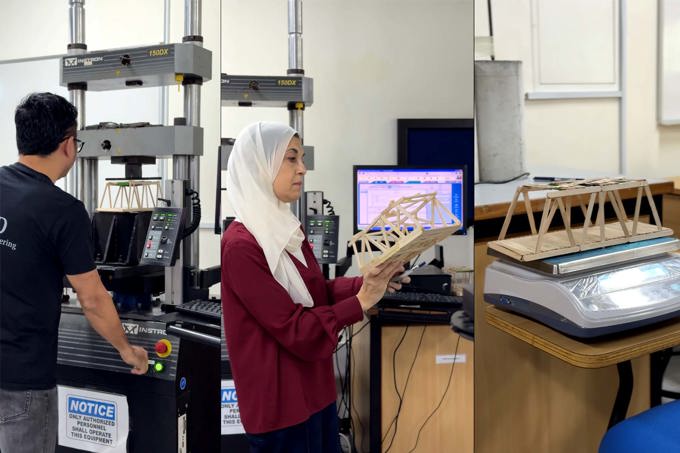
Perhaps the most visually impactful segment of the event was the Truss Bridge Design Challenge. This task focused on civil and structural engineering principles, requiring teams to design and construct physical truss bridges using limited materials. The objective was to achieve the highest strength-to-weight ratio, a fundamental concept in structural engineering.
What set this challenge apart was the testing phase. The student-built bridges were evaluated in the American University in Dubai’s Structural Engineering Lab using specialized, industrial-grade equipment. To maximize engagement and transparency, the testing process was live-streamed, allowing all participants to monitor the real-time performance of their designs and observe the exact point of structural failure. Tina Malak Rahrouh, a participating student from Al Maarifa International School, noted the value of this practical application, stating, “We learned a lot while designing and working on this bridge.”
Why High School Students Should Monitor Engineering Competitions
For high school students contemplating a career in STEM, passive learning is rarely sufficient to clarify complex career paths. Actively participating in or even observing events like this engineering competition provides critical insights that textbooks cannot offer. Parents, career counselors, and teachers should monitor how students respond to these challenges to better guide their academic choices.
When students are placed in high-pressure, time-constrained environments, they naturally gravitate toward the tasks that align with their innate abilities—whether that is coding a game, drafting a 3D model, or calculating load-bearing capacities. Recognizing these natural inclinations early allows students to tailor their high school coursework, select appropriate extracurricular activities, and ultimately choose the right university engineering major.
Furthermore, tracking the outcomes of these competitions helps students understand the baseline skill level expected by top-tier universities. The ingenuity displayed by the 84 participants at the American University in Dubai event sets a clear benchmark for academic excellence in the UAE.
Bridging the Gap Between High School Theory and University Practice
Dr. Wael Bazzi, Dean of the School of Engineering and Professor of Computer Engineering at the American University in Dubai, highlighted the core philosophy behind the event: providing opportunities that bridge theory and practice. He noted that cultivating creativity, critical thinking, and hands-on problem-solving is central to the university’s mission, even in competitive or virtual environments.
This philosophy is deeply embedded in the university’s broader curriculum. The School of Engineering offers fully accredited undergraduate programs in Civil Engineering, Computer Engineering, Electrical Engineering, and Mechanical Engineering, alongside graduate programs in Artificial Intelligence and Construction Management. The high school competition serves as a microcosm of these degree programs, giving prospective students a transparent look at the pedagogical strategies employed by the faculty.
By engaging with university-level labs, equipment, and faculty members early on, high school students demystify the higher education experience. The anxiety often associated with transitioning to university-level STEM studies is significantly reduced when students have already successfully navigated a university-sponsored engineering challenge.
Explore our related articles for further reading on STEM education pathways.
The Role of Institutions in Cultivating UAE Future Innovators
The American University in Dubai’s commitment to hosting this annual event underscores a broader institutional responsibility within the UAE. As the nation continues to diversify its economy and invest heavily in sectors like advanced technology, renewable energy, and smart infrastructure, the reliance on homegrown engineering talent has never been greater.
Universities play a critical role in this ecosystem. They cannot simply wait for students to arrive at their doors; they must actively participate in the development of the future innovator pipeline. Events like this engineering competition foster a culture of innovation at the high school level. They bring together schools from across the region—including Al Maarifa International School (Sharjah), Dubai National School – Al Barsha, Dubai International Academy – Emirates Hills, Uptown International School, Dunes International School, and Applied Technology Schools Dubai—creating a collaborative yet competitive network of young STEM enthusiasts.
This regional networking is just as valuable as the technical skills learned. Students exchange ideas, observe different approaches to the same problem, and build relationships with peers who share their academic ambitions. This collaborative spirit is precisely what is required in professional engineering environments, where large-scale projects are rarely executed by individuals working in isolation.
Actionable Steps for Aspiring Engineering Students
For students inspired by the outcomes of the American University in Dubai engineering competition, there are several concrete steps to take to prepare for a future in the field:
- Develop a Technical Portfolio: Begin documenting projects, such as coded games, 3D models, or structural designs. A portfolio provides tangible proof of skills during university admissions.
- Utilize Free CAD and Coding Resources: Tools like Tinkercad, AutoCAD, Python, and C++ are readily accessible online. Familiarity with these platforms provides a significant head start.
- Focus on Mathematics and Physics Fundamentals: While hands-on design is crucial, all engineering challenges are ultimately governed by mathematical and physical laws. Strong foundational knowledge is non-negotiable.
- Seek Out Team-Based Competitions: Engineering is a collaborative discipline. Actively seek out science fairs, hackathons, and design competitions to build teamwork and communication skills.
The path to becoming a successful engineer requires dedication, curiosity, and a willingness to continuously test and refine ideas. The students who recently competed at the American University in Dubai have demonstrated these exact qualities, setting a high standard for their peers across the UAE.
Submit your application today to start your engineering journey.