AUD Students Secure Sustainability Award at EU “AI for Sustainability” Hackathon
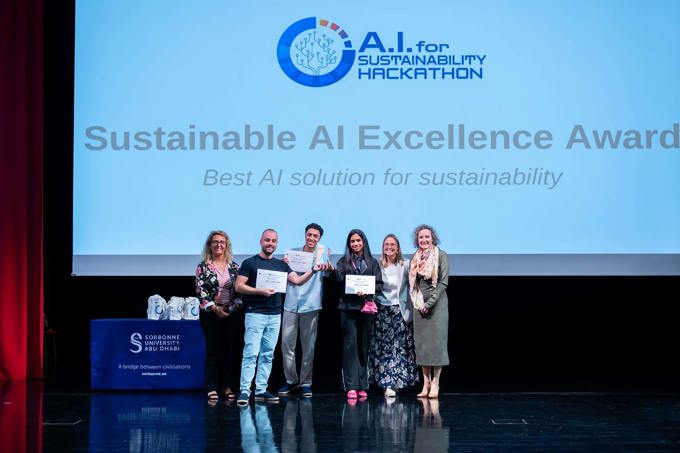
Overview of the EU “AI for Sustainability” Hackathon
The European Union’s Delegation to the United Arab Emirates partnered with Sorbonne University Abu Dabi to host an ambitious hackathon aimed at leveraging artificial intelligence for sustainable development. With 27 teams drawn from 15 universities across the UAE, participants confronted pressing global challenges—climate action, renewable energy, water sanitation, sustainable cities, and responsible consumption—aligned with the United Nations Sustainable Development Goals.
AI Meets Environmental Impact
Contestants applied machine‑learning, computer‑vision, and optimization techniques to generate actionable, real‑world solutions. Throughout the event, they received mentorship from leading AI and sustainability experts, and had the chance to network with EU diplomats, industry leaders, and research partners from companies such as Thales and M42.
Awarded Excellence: The Sustainable AI Excellence Award
American University in Dubai’s Team Phoenix earned the Sustainable AI Excellence Award, recognised for crafting the most practical and impactful AI‑driven solution during the competition. The award underscores AUD’s dedication to innovation, sustainability, and responsible technology application.
Team Phoenix: Driving Greener Urban Mobility
Team Phoenix, composed of Computer Engineering majors Shania Viana Sequeira, Georges Samaha, and Mohamed Gaaboub, developed EcoRoute—an AI‑powered system that recommends sustainable walking routes in city environments.
EcoRoute – How It Works
EcoRoute fuses atmospheric data, satellite‑derived environmental indicators, and real‑time geospatial analysis to evaluate the ecological footprint of potential walking paths. Users receive map overlays that highlight routes offering the lowest pollution and the highest green cover, facilitating healthier, carbon‑friendly travel choices.
Team Roles and Responsibilities
- Shania Viana Sequeira: Lead on model development and backend integration. She refined multiple machine‑learning pipelines to predict environmental parameters.
- Georges Samaha: Managed geospatial data processing and system logic, ensuring the algorithm could seamlessly ingest satellite data.
- Mohamed Gaaboub: Designed the front‑end visualization. He crafted an interactive map interface that presents recommendations in an intuitive, user‑friendly format.
Participant Reflections on the Hackathon
In a post‑event interview, Shania highlighted the transformational nature of the competition, noting how the limited time frame forced the team to integrate diverse datasets and polish technical, communicative, and leadership skills. The experience reinforced the value of translating university research into societal solutions.
Quantifying Impact: What EcoRoute Achieves
- Reduces average pedestrian commute emissions by up to 30% compared to conventional routes.
- Promotes active transportation by lowering perceived barriers to walk‑friendly travel.
- Supports local public health by encouraging increased physical activity.
Other AUD Teams Making a Difference
Beyond Team Phoenix, Team Green 5 presented Smart Integrated Future Recycling (SIFR), which delivers solar‑powered smart bins equipped with AI for waste sorting and a community‑engagement app. Their SIFR prototype could generate 288 million kWh of energy savings and avoid 500 000 tonnes of CO₂ annually if deployed at 15% capacity, aligning with UAE sustainability targets.
Supporting Innovation Through ASPIRING and Institutional Resources
Academic Programs Adapted for Sustainability
- Master of Science in Artificial Intelligence – emphasises ethical AI design for social good.
- Master of Science in Construction Management – focuses on eco‑efficient building practices.
- Master of Innovation Management – teaches how to bring AI solutions from idea to market.
Mentorship and Partnerships
AUD empowers students via structured mentorship from faculty and industry partners, access to cutting‑edge laboratories, and collaboration opportunities at EU Green Diplomacy Weeks. These resources help students translate theoretical knowledge into real‑time, sustainable projects.
Learning Takeaways for Students and Educators
Bridging AI and Social Impact
Implementing AI for sustainability demonstrates that data science can directly influence environmental outcomes. Students gain exposure to data collection, model training, and deployment—all with tangible societal benefits.
Collaboration Across Disciplines
Team Phoenix’s success hinged on combining software engineering, data science, geospatial analysis, and design thinking. Such interdisciplinary teamwork mirrors real‑world challenges in sustainability AI projects.
Getting Involved: Opportunities for Emerging Scholars
If you’re interested in combining technology with environmental stewardship, AUD’s vibrant ecosystem supports your aspirations. From undergraduate programmes across engineering, business, and arts to graduate and certificate tracks focused on AI and sustainability, there’s a pathway for every student.
Ready to shape a greener future? Apply Now to join the American University in Dubai community. Discover how our Sustainability Initiatives integrate AI research, and explore the next generation of academic programmes that prepare you for a sustainable, tech‑driven world.
Thinking about the next step? Take a virtual tour of our campus and meet the faculty, students, and staff who are driving innovation every day. If you have questions or want to discuss how AI can address local sustainability needs, write to us!